

Table of Contents
- Why Coffee Works as a Steak Seasoning
- Best Coffee for Steak Rub: Grind Size and Type
- Building Your Coffee Steak Rub Recipe
- How Long to Leave Dry Rub on Steak
- Preparing and Applying the Rub
- Grilling Coffee-Rubbed Steak for the Perfect Crust
- Troubleshooting Bitter or Weak Flavors
- Frequently Asked Questions
Last Updated: October 5, 2026
Why Coffee Works as a Steak Seasoning
When you season steaks with coffee, the deep, roasted flavors complement beef beautifully, adding richness without overpowering the meat.
Coffee contains compounds that enhance umami, the savory fifth taste, and its bitterness balances the fat in beef, creating a complex, smoky crust.
You don't need much: a light coating of coffee-based dry rub transforms an ordinary steak into something restaurant-quality. Experienced grillers have used coffee rubs for years, it's proven technique, not a trend.
Best Coffee for Steak Rub: Grind Size and Type
Grind size drives two things at once: how the crust forms and how bitter the finished steak tastes. Get it wrong and your rub either slides off or tastes like burnt espresso.
The grind-size spectrum, and what each one does:
- Coarse (sea-salt texture, like a French press grind): Large particles sit on top of the meat and flake off during the first flip, but they release flavor slowly and resist scorching. Best for long, low cooks and a subtle coffee note.
- Medium (table-salt texture, like a drip or pour-over grind): The practical default. Particles press into the surface to form a continuous crust without dissolving into paste, the grind most rub recipes assume.
- Fine (powdered-sugar texture, like an espresso grind): Clings aggressively and produces the darkest crust, but its surface area extracts and burns faster. Use smaller quantities at slightly lower heat.
- Instant coffee (crystals or powder): Dissolves rather than crusts, so it seasons the meat but adds almost no texture. Useful in a wet rub or marinade, not as the backbone of a dry crust.
Why grind changes bitterness: Bitterness comes from compounds extracted by heat and moisture, and the finer the grind, the more surface area is exposed and the faster those compounds emerge. A rub that tastes balanced dry can taste harsh on the finished steak if ground too fine.
Roast level matters too. Dark roasts bring roasty, smoky notes that read as "grill" flavor; light roasts can taste thin or sour against beef. Medium to medium-dark is safest.
Decaf vs. regular: Decaffeination removes some flavor compounds along with caffeine, so decaf rubs tend to taste slightly flatter. It works, but you may want to lean a little harder on the supporting spices.
A quick test: rub a pinch between your fingers. Fine sand that disappears into skin is too fine for a crust; coarse cornmeal is too coarse to bond. You want gritty but not powdery.
Building Your Coffee Steak Rub Recipe
A great coffee steak rub combines coffee with complementary ingredients. The structure matters. You need balance.
Core Coffee Rub Ingredients and Ratios
Start with a foundation:
- Coffee grounds: 3 tablespoons (this is your base)
- Salt: 1 tablespoon (enhances all flavors)
- Cracked black pepper: 1 tablespoon (adds heat and sharpness)
- Brown sugar: 1 tablespoon (balances bitterness, adds caramelization)
Mix these four in a small bowl, your baseline for any cut of steak.
The ratio is roughly 3:1:1:1 by volume, keeping coffee dominant while salt and pepper provide structure and brown sugar caramelizes during grilling.
Scaling up: If you're seasoning multiple steaks, multiply all amounts equally. This gives you the convenience of pre-mixed ratios without measuring.
Adding Complementary Spices
Once you have your base, choose 1-3 complementary spices:
- Smoked paprika: 1 teaspoon (adds smokiness without heat)
- Cumin: ½ teaspoon (earthy, warm notes)
- Garlic powder: ½ teaspoon (savory depth)
- Onion powder: ½ teaspoon (sweetness and umami)
- Chile powder: ½ teaspoon (mild heat, fruity undertones)
- Cinnamon: ¼ teaspoon (subtle warmth, pairs with coffee)
Don't use all of them, too many spices muddy the coffee flavor.
A common mistake is too much paprika or chile powder, which can dominate the coffee. Start conservative; you can always add more next time.
Havens Coffee Rub offers multiple flavor profiles so you don't have to guess. The Mushroom & Onion blend adds earthy depth. The Spicy blend brings heat without overwhelming coffee notes.

How Long to Leave Dry Rub on Steak
Timing matters when you season steaks with coffee: too short and flavors don't penetrate, too long and salt dries out the meat.
The ideal window is 40 minutes to 2 hours before grilling. This gives the rub time to adhere and flavors to start permeating the meat. For most backyard grilling, 1 hour is perfect.
Why 40 minutes minimum? The rub needs time to stick and begin breaking down muscle fibers; less than that and the seasoning just sits on the surface.
Why not longer than 2 hours? Salt draws moisture from the meat, so beyond 2 hours the surface dries out and won't sear properly.
The overnight exception: Some pitmasters leave rubs overnight, but that only works with very little salt. With a standard amount, stick to the 40-minute to 2-hour window.
If you forget and leave the rub on longer, don't panic. Wipe off excess before grilling. You'll still get good flavor.
Preparing and Applying the Rub
How you apply the rub determines how well it sticks and how even the crust becomes.
Prepping Your Steak
Start with a dry steak. This is non-negotiable.
Pat your steak completely dry with paper towels. Surface moisture prevents the rub from adhering and creates steam that blocks a proper crust.
Let the steak sit at room temperature for 20-30 minutes before applying the rub; cold meat cooks unevenly and won't sear as well.
Remove any excess surface moisture one more time right before seasoning. This is your final step before the rub goes on.
Mushroom & Onion Havens Gourmet Coffee Rub →
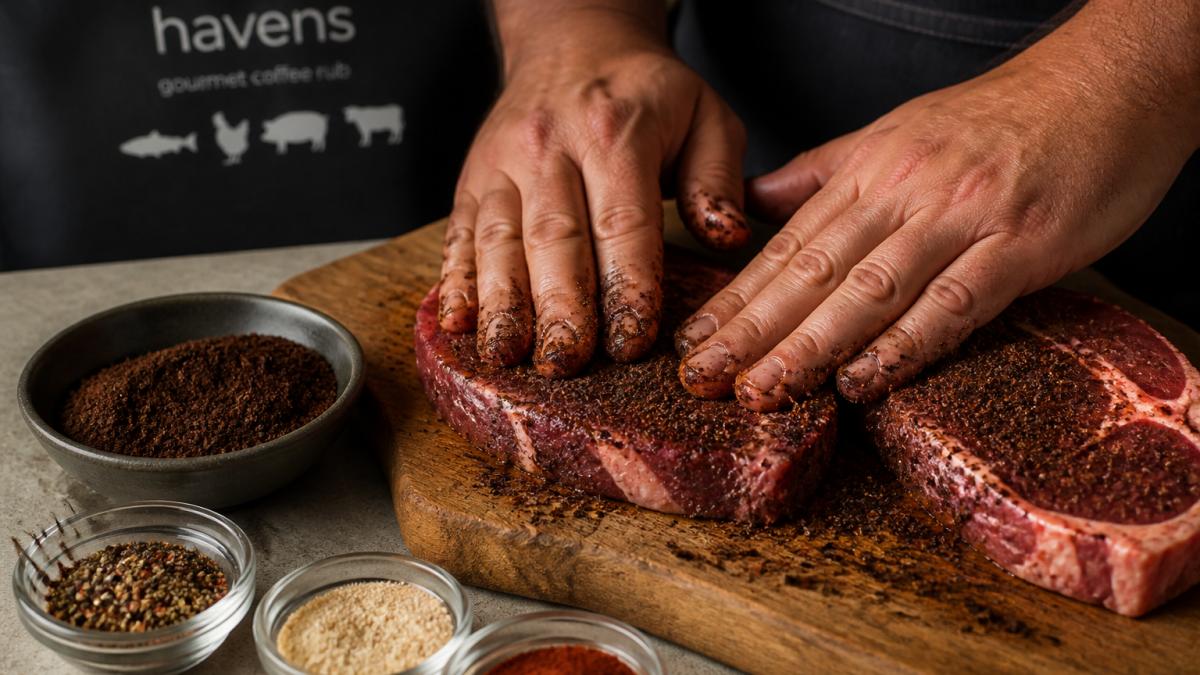
Coating Both Sides Generously
Generously is the key word. Don't be shy with the rub.
Use your fingers to press the rub into both sides, don't just sprinkle it. The rub should form a visible coating over the entire surface.
For a typical New York strip or ribeye, use about 1 teaspoon of rub per side. Adjust based on steak size. Larger cuts like tomahawk steaks need more.
Both sides matter equally. Don't focus only on the side that will face the grill grates.
The edges too. Run your fingers along them so all exposed meat is coated, not just the flat surfaces.
A common mistake is applying the rub too lightly. You want a visible, dark coating, a thin dusting won't give you the crust, flavor or texture you're after.
Grilling Coffee-Rubbed Steak for the Perfect Crust
Coffee and sugar both burn before beef does, so the goal is a dark crust without crossing into acrid, managing both your cooking surface's temperature and the steak's internal temperature.
Internal Temperature Targets
Pull the steak based on a probe thermometer, not the clock. Carryover cooking will raise the internal temperature another 5-10°F while the steak rests.
- Rare: pull at 120-125°F
- Medium-rare: pull at 130-135°F
- Medium: pull at 140-145°F
- Medium-well: pull at 150-155°F
Insert the probe into the thickest part, avoiding bone and fat. For thin cuts like a minute steak, skip the thermometer and go by feel, they'll blow past medium-rare in under two minutes per side.
Resting
Rest the steak on a wire rack or cutting board, loosely tented with foil, for 5-10 minutes depending on thickness, about 5 minutes for a 1-inch steak, closer to 10 for a 2-inch tomahawk. Resting redistributes juices and firms the crust. Slice against the grain.
Method Comparison: Grill, Skillet, and Oven
Grill (direct heat): Best for steaks 1 inch or thinner and for grill marks and smoke. Preheat to 450-500°F, leave the steak alone for 3-4 minutes, flip once, and cook another 3-4 minutes. Watch for flare-ups from dripping fat igniting the sugar, keep a cool zone ready.
Cast-iron skillet: Best for crust control indoors. Get the pan ripping hot, add a high-smoke-point oil, and lay the steak away from you. Expect more smoke than a grill, coffee and sugar scorch faster against direct metal, so drop the heat slightly after the initial sear. You can also baste with butter and aromatics in the last minute.
Oven (reverse sear): Best for thick cuts over 1.5 inches. Set the oven to 225-250°F, put the steak on a wire rack over a sheet pan, and cook until 15-20°F below your target. Then sear hard in a skillet or on a hot grill for 1-2 minutes per side.
Keeping Coffee and Sugar From Burning
The sugar in a coffee rub caramelizes around 320-350°F and turns bitter past that; coffee grounds follow a similar curve. Two practical levers:
- Lower the surface heat slightly if the crust goes from dark brown to black within 90 seconds. Pull the steak, let the pan or grill cool a minute, then continue.
- Use a two-zone setup, sear over the hot side, then move to the cool side to finish. This is the most effective way to get a dark crust without a burnt one.
A Note on Thickness
Thin steaks (under 3/4 inch) cook too fast for a coffee rub to do much beyond the surface, use a light dusting. Thick steaks (1.5 inches and up) are where the rub earns its keep, since the long cook lets the crust develop without overcooking the interior.
Troubleshooting Bitter or Weak Flavors
Sometimes a coffee-rubbed steak doesn't taste right. Here's how to fix common issues.
Flavor tastes too bitter: You likely used too much coffee or an over-roasted bean.
Can't taste the coffee at all: The rub was too light or fell off.
Rub tastes one-dimensional: Add complementary spices, a pinch of cumin or smoked paprika rounds out the flavor, since coffee alone can taste flat.
Crust didn't form: Your grill wasn't hot enough or you moved the steak too much.
Steak tastes too salty: You used too much salt. Cut it in half next time, salt draws moisture, so less is often more with dry rubs.
If you're experimenting, keep notes: what coffee you used, how hot the grill was, how long the rub sat.
Grilling a perfect steak takes practice, but a great coffee rub handles much of the flavor work for you.
Havens Coffee Rub brings gourmet, island-inspired flavor to every steak.
Frequently Asked Questions
What kind of coffee is best for a steak rub?
Medium to dark roast ground coffee works best for steak rubs. Medium roasts offer balanced flavor without excessive bitterness, while dark roasts deliver a deeper, smokier profile. Avoid instant coffee, it dissolves too quickly and won't create the texture needed for a proper crust. Finely ground coffee blends better into the rub mixture and adheres to the steak more evenly than coarse grounds.
How long should you leave a coffee rub on steak before grilling?
Apply the rub 15-30 minutes before grilling for best results. This allows the spices to adhere and flavors to begin penetrating the meat without over-salting it. For deeper flavor, you can apply it up to 2 hours ahead, but avoid overnight application as the salt will draw out too much moisture and toughen the surface. Pat the steak dry before applying the rub to ensure maximum adhesion.
Does coffee make steak taste like coffee?
No. When properly balanced in a dry rub with salt, pepper, and complementary spices like paprika and cumin, coffee adds a smoky, savory depth rather than a coffee flavor. The coffee grounds contribute to crust development and enhance the meat's natural flavors. The key is using the right proportion, typically 1-2 tablespoons per steak, so coffee enhances rather than dominates.
Can you use instant coffee in a steak rub?
Instant coffee is not recommended for dry rubs. It dissolves too quickly when it contacts the meat's moisture, creating a paste instead of a flavorful crust. Ground coffee, particularly medium to dark roast varieties, provides the texture and staying power needed for searing. Instant coffee also tends to be more bitter and won't create the same smoky complexity that whole ground coffee delivers.